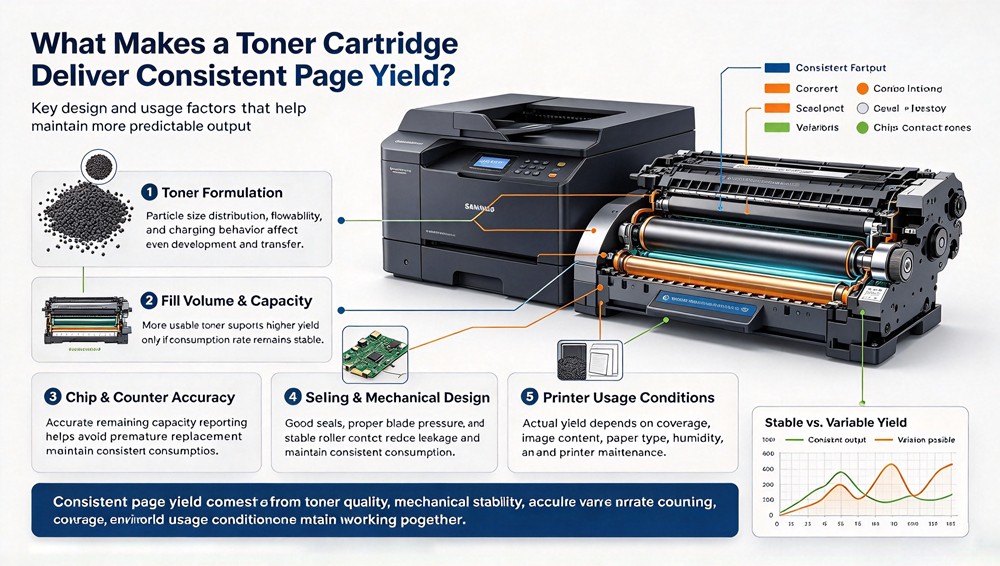
When buyers compare toner cartridges, page yield is usually the first metric they check. A higher rated yield promises better value for your end customers. Yet in real office settings, two cartridges with identical rated yield can deliver drastically different results. What distinguishes a cartridge that reliably hits its rated page yield from one that underperforms?
The answer lies in meticulous engineering and material science.
1. Precision in Toner Particles
Toner is far more than simple powder — it is a precisely formulated material. Premium toner consists of uniform, fine particles with stable melting points. It transfers cleanly onto paper with minimal waste. Irregular toner particles require more material to maintain consistent print density, driving up consumption and cutting real-world page yield.
2. Efficient Cartridge Architecture
The way toner flows within the cartridge is just as critical as the toner itself. A well-engineered cartridge comes with tight internal sealing and a seamless powder feeding system. It distributes toner evenly across the drum, maximizing the total printable pages before it runs empty.
3. Testing in Real-World Conditions
To guarantee dependable performance, reputable manufacturers test page yield under standard ISO conditions, alongside real-use scenarios. At TOHITA, we track performance across every production batch. Our cartridges maintain steady output and consistent page yield from the very first print to the last.
Based in Zhuhai, the global hub for printing consumables, we combine precision toner formulations with rigorous quality control. Whether you supply high-volume offices or retail clients, our compatible toner cartridges are built to uphold the performance you promise your customers.
Consistent page yield never happens by chance — it comes from precise, rigorous engineering.
Reach out today to source verified compatible toners with stable page yield and fewer post-sales issues.